
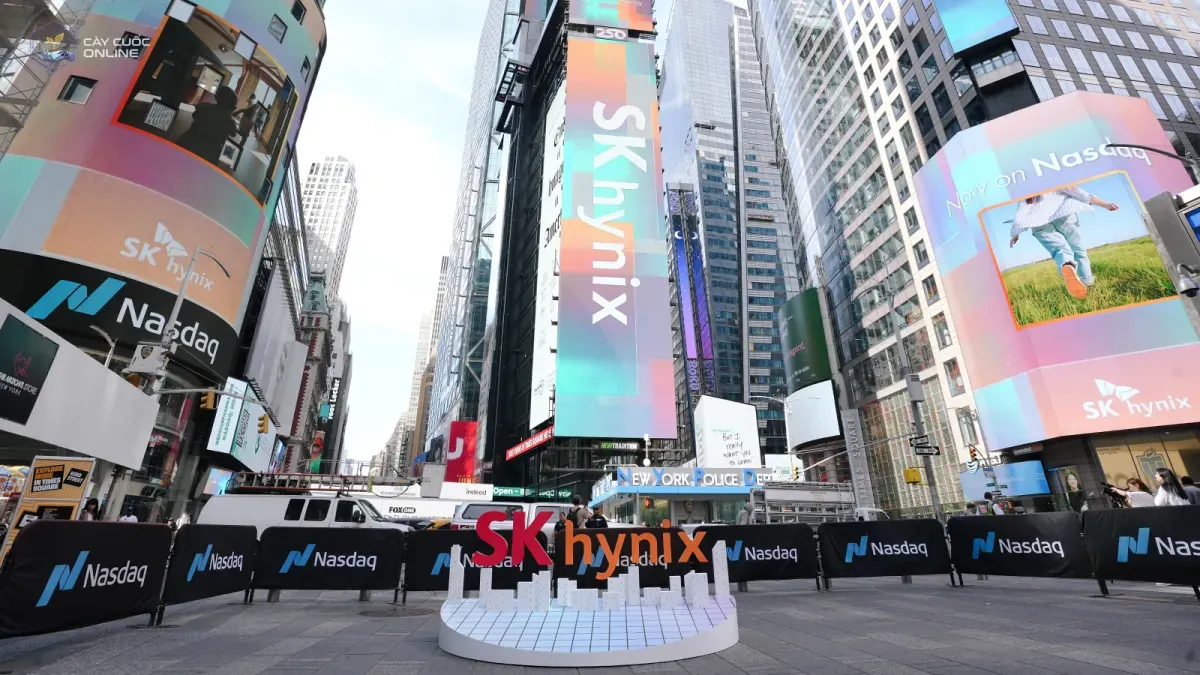
IPO lớn nhất lịch sử tại Mỹ của SK Hynix đạt 26.5 tỷ USD, thúc đẩy bởi chip HBM cho AI. Mỹ đang kêu gọi SK Hynix và Samsung xây nhà máy tại đây.
SK Hynix’s Historic U.S. Debut and Market Performance
Unprecedented Scale and Investor Enthusiasm
SK Hynix’s U.S. market debut, raising an astounding $26.5 billion (KRW 40 trillion), marks a pivotal moment, not just for the company but for the global financial landscape. This colossal sum was garnered through the sale of 177.9 million American depositary shares (ADRs) at $149 each, strategically priced to allow U.S. investors accessible entry at roughly a tenth of the cost of a full share in Seoul. Critically, this deal now stands as the largest-ever U.S. debut by a non-American entity, surpassing Alibaba’s $25 billion IPO in 2014. This unprecedented scale underscores the immense investor appetite for companies at the forefront of the AI revolution, demonstrating a strong vote of confidence in SK Hynix’s strategic positioning and future growth prospects in a highly competitive market.
Strong Initial Trading and Premium Pricing
The immediate market reception for SK Hynix’s ADRs was nothing short of spectacular, signaling robust investor confidence and strong demand. Upon opening, the stock surged an impressive 14% above its initial public offering price, with the price continuing its upward trajectory during early trading on Friday. This remarkable performance occurred despite the shares being priced at a 2.7% premium compared to its own three-day average in Seoul, as detailed in its Korea Stock Exchange filing. Further amplifying the demand narrative, media reports indicated that the offering was oversubscribed by more than seven times the available shares. This extraordinary oversubscription highlights a powerful market conviction in SK Hynix’s value proposition, driven significantly by its critical role in the burgeoning AI chip ecosystem, enabling it to command premium pricing even in a foreign market.
The AI Chip Catalyst: HBM and Nvidia’s Indispensability
High-Bandwidth Memory (HBM) as the Core Driver
The underlying force behind SK Hynix’s phenomenal market success is its undisputed leadership in High-Bandwidth Memory (HBM). HBM is not merely a memory component; it is a fundamental, performance-critical technology essential for the functioning of cutting-edge AI Graphics Processing Units (GPUs). These specialized memory modules allow for significantly faster data transfer speeds and greater bandwidth compared to traditional DRAM, which is crucial for handling the immense computational demands of AI workloads, such as deep learning and neural networks. As the demand for AI accelerates across various industries, the need for advanced HBM solutions becomes paramount, positioning SK Hynix as an indispensable provider at the very heart of the AI computing infrastructure and cementing its long-term strategic value to global technology giants.
The Nvidia-SK Hynix Symbiosis
A significant factor contributing to SK Hynix’s elevated status and market valuation is its symbiotic relationship with Nvidia, the undisputed leader in AI GPUs. Nvidia’s reliance on SK Hynix as one of its primary suppliers for HBM components creates a powerful strategic advantage for the South Korean chipmaker. This deep integration into Nvidia’s supply chain means that as Nvidia’s dominance in the AI market grows, so too does SK Hynix’s critical role and revenue potential. This partnership not only validates SK Hynix’s technological prowess and manufacturing capabilities but also provides a clear, high-growth revenue stream that is directly tied to the exponential expansion of the AI industry. The indispensable nature of this collaboration significantly mitigates perceived risks and enhances SK Hynix’s attractiveness to global investors, transforming it into a linchpin of the global AI supply chain.
Defying the “Korea Discount”: A New Era for Korean Tech
Understanding the “Korea Discount” Phenomenon
For decades, Korean companies have grappled with the “Korea Discount,” a persistent valuation gap where their stocks trade at lower multiples compared to global peers. This discount has historically been attributed to a confluence of factors, primarily including complex and often opaque corporate governance structures, which can obscure shareholder value and decision-making processes. Additionally, traditionally low shareholder returns, often prioritizing reinvestment over dividends, have deterred international investors seeking immediate value. Regulatory uncertainty and geopolitical risks, particularly those related to North Korea, further compounded these concerns, creating a cautious investment environment. These systemic issues have historically made it challenging for even leading Korean firms to achieve premium valuations on the international stage, limiting capital inflow and global recognition for their inherent business strengths.
How AI Chip Dominance Overcame Valuation Gaps
SK Hynix’s remarkable U.S. debut and premium valuation represent a significant departure from the entrenched “Korea Discount.” The company’s success unequivocally demonstrates that its critical role in the burgeoning AI chip market has effectively overridden traditional investor hesitations. By manufacturing high-bandwidth memory (HBM), a cornerstone component for AI GPUs, SK Hynix has become an indispensable player in a sector experiencing explosive growth. The overwhelming global demand for AI infrastructure, coupled with SK Hynix’s technological leadership and strategic supply chain partnerships (especially with Nvidia), positioned it as an essential global asset. Its fundamental business strength and future growth prospects in AI far outweighed concerns about corporate governance or geopolitical risks, fundamentally re-rating its perceived value and ushering in a potential new era where industry-critical technological leadership can transcend national market discounts.
Strategic Capital Deployment for Global Leadership
Expanding Production Capacity in South Korea
The substantial capital raised from U.S. investors is strategically earmarked for reinforcing SK Hynix’s manufacturing capabilities, primarily within South Korea. A significant portion will be allocated to the construction of a new fabrication plant (fab), which is already underway, specifically designed to address the escalating worldwide shortage of memory chips driven by the exponential growth of AI technologies. This investment is critical for scaling production to meet surging demand for HBM and other advanced memory solutions. Furthermore, funds will also be directed towards establishing a new packaging facility within the country. This integrated approach ensures that SK Hynix can control more aspects of its production, from wafer fabrication to final product assembly, enhancing supply chain resilience and accelerating time-to-market for its crucial AI-enabling products, solidifying its market leadership and responsiveness.
Investment in Next-Generation Technology: EUV Scanners
A key strategic allocation of the newly raised capital is the procurement of Extreme Ultraviolet (EUV) scanners. These highly advanced, multi-million dollar machines are absolutely indispensable for the manufacturing of next-generation, high-density, and high-performance chips. EUV lithography allows for the creation of incredibly intricate patterns on silicon wafers, enabling the production of smaller, more powerful, and more energy-efficient integrated circuits. By investing in EUV technology, SK Hynix is not only future-proofing its manufacturing capabilities but also ensuring its ability to maintain a technological edge over competitors in the rapidly evolving semiconductor landscape. This investment underscores the company’s commitment to innovation and its long-term vision to remain at the forefront of memory chip technology, particularly as AI applications demand ever more sophisticated and dense memory solutions.
Geopolitical Implications and the Global Chip Race
U.S. Push for Domestic Chip Manufacturing
The visit by U.S. Commerce Secretary Howard Lutnick to a Micron event, coupled with his reported discussions with Samsung and SK Hynix about establishing new factories in the U.S., highlights a significant geopolitical imperative. The U.S. government is increasingly vocal about its desire to reduce its reliance on a few key nations, particularly South Korea and Taiwan, for critical semiconductor manufacturing. This initiative is driven by national security concerns, economic competitiveness, and the lessons learned from recent supply chain disruptions. By encouraging leading memory makers like SK Hynix to build fabrication plants on American soil, the U.S. aims to onshore a greater portion of the semiconductor supply chain, fostering domestic job creation, strengthening its technological independence, and diversifying manufacturing risks, thereby reshaping the global chip production landscape to mitigate future vulnerabilities and secure its technological future.
Strategic Competition and Supply Chain Diversification
The U.S. government’s proactive engagement with global chip giants like SK Hynix and Samsung signifies a broader strategic competition for technological dominance and supply chain resilience. The explicit goal, “not to let South Korea continue to be the country that dominates this important tech,” reveals a clear intent to rebalance global semiconductor manufacturing capabilities. This move has profound implications for international trade and investment, potentially altering existing global supply chains and fostering greater regionalization of chip production. For companies like SK Hynix, deciding where to build new fabs becomes a complex calculus involving incentives, labor costs, infrastructure, and geopolitical relationships. This push for diversification is not merely economic; it is a critical national security strategy aimed at ensuring stable access to vital technology components and preventing any single nation from holding undue leverage over the global tech industry, thereby creating a more distributed and resilient semiconductor ecosystem worldwide.